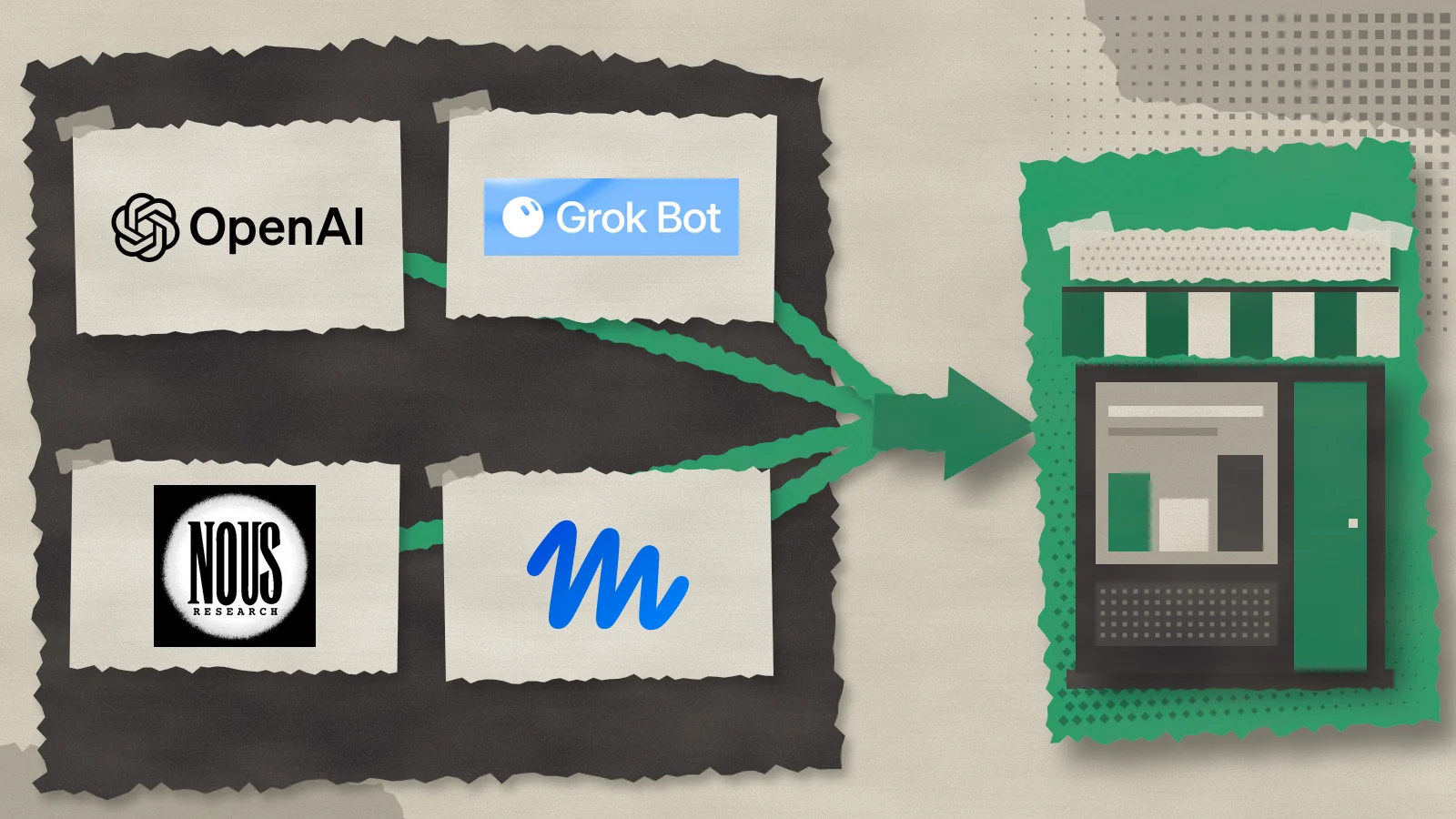
On 3 October, Miles Deutscher posted a list of personal AI agents on X with a warning: if you don’t use at least one, you’re falling behind. That is his opinion, and it leads to a more practical question: which of those agents can a Spanish SME use today, and what do they cost? We checked everything again on 27 October 2026 against the official websites. We start with OpenClaw vs Hermes Agent, both open source, then cover Dots and Bot, and finish with ’s Muse.
His list includes Muse, Bot, Hermes, Dots, Cue (by Manus) and OpenClaw, the last one with a question mark:
Deutscher argues that anyone not using at least one is “falling behind in tech and leaving massive productivity on the table as a result”. Cue is not part of this comparison.
A note before we start. At LetBrand we use Bot every day, and what we say about it comes from our own experience. There is no sponsorship or commercial agreement with SpaceXAI or Cursor. For every other tool we only report what their official websites and documentation say.
What a personal AI agent is
A personal agent takes on a job and keeps working on its own: it opens a browser, uses your apps and hands the finished work back to you. Of the five, three are cloud services run by a company (Dots, Bot and Muse), and their documentation says they ask for your approval before sensitive actions. The other two, Hermes Agent and OpenClaw, are open-source programs you install and configure yourself.
OpenClaw vs Hermes Agent: the two open-source agents
OpenClaw already has its own article on our blog: what is OpenClaw. Since July 2026 it has been stewarded by the OpenClaw Foundation, a US non-profit. Its website is explicit: the whole product is MIT licensed and “There is no enterprise edition and no paid version”. It has a desktop app for Mac, Windows and Linux, and it also installs on a server, with the model you prefer, and you talk to it on WhatsApp, Telegram, Slack or any of its 29 channels. Memory, credentials and state stay on your machine. The foundation’s donors include , Amazon and Red Hat, and its website makes clear that OpenClaw is not an product.
On 29 September the project’s official blog announced OpenClaw Enterprise, an open-source platform for managing agents in sensitive environments. It started at , which donated it to the foundation, and was developed with Red Hat and NVIDIA. It is still meant for internal pilots, with 1.0 planned for later this year, and according to the announcement it “will always be free for any organization to use”.
Its README warns that, unless you configure sandboxing, tools run directly on the host where it is installed, so someone has to decide what the agent may touch before it is connected to company accounts.
Hermes Agent is Nous Research’s project, also MIT licensed. It has a desktop app for Mac, Windows and Linux and works with the model you choose: Nous Portal, OpenRouter, or your own endpoint. It talks to you on Telegram, Discord, Slack, WhatsApp, Signal or email.
The practical difference from OpenClaw is that Nous offers a hosted version, Hermes Cloud. You deploy the agent on a cloud instance and pay for usage with Nous credits: you need at least 2 dollars in credits or an active subscription. You are billed daily for the time the instance is running plus storage, and a stopped instance only pays for storage. The possible server locations include several in Europe, such as Amsterdam, Paris, Frankfurt and Stockholm, although Nous picks the closest one with availability. The model and tools are billed separately.
Between OpenClaw and Hermes Agent, the choice mostly comes down to who will maintain it. Both are free, let you pick the model and need someone technical to set up permissions and sandboxing. OpenClaw always runs on a machine of yours; Hermes also offers Hermes Cloud for those who don’t want to look after a server.
Dots vs Grok Bot: this autumn’s two newcomers
announced Dots on 29 September at its DevDay, which we summarised here. A dot is an always-on agent powered by , with its own cloud computer and browser, and it keeps working when your own computer is off. You create it in the mobile or desktop app, or in a desktop browser, and then you can message it in , Slack or Teams, or call it. According to , conversations with your dot don’t count toward usage limits.
For a Spanish SME, the key detail is on ’s access page. The Pro plans (Pro 100, Pro 200 and Pro 500) offer Dots to users over 18 outside the European Economic Area, the United Kingdom and Switzerland. In Spain that leaves Business Premium, which is rolling out worldwide, and Enterprise, where Dots is off until an administrator turns it on. The Business plan is aimed at teams of 2 to 200 people, and its Premium seat, the one that includes Dots, costs 100 dollars per user per month billed annually or 125 billed monthly. The rollout is gradual and access can take a while to appear.
Bot is SpaceXAI’s agent, built with Cursor. It launched in beta on 11 August and works in a similar way: each Bot has a name, a job and a persistent cloud computer with a browser, files and a terminal, and it comes back to you when something needs your approval. In October the way you buy it changed: it now comes with The X Subscription, SpaceXAI’s single plan for , Cursor and X. Bot is included from the Premium plan, at 30 dollars a month (300 a year), and in Super and Ultra; the 8-dollar Plus plan does not include it. If you already paid for Cursor Pro, Teams or SuperGrok, you can keep your legacy plan, which still includes it. Usage comes from a weekly pool shared with Cursor and the apps. There are apps for macOS, Windows, Linux, iPhone and Android.
We found no official information on country availability. We use it every day from Spain, mostly for research and content preparation: the source checks and the images in this article were prepared with Bot, and the team reviews them before publishing. Its documentation explains one detail worth knowing: all the Bots on an account share the same cloud computer, with its files and sessions, so any credential you leave there can be used by any of your Bots.
Dots and Bot are cloud agents that work on their own and ask for approval on sensitive steps. In Spain, Dots requires a business plan, while Bot comes with an individual subscription, from the Premium plan on The X Subscription.
Meta’s Muse: not in Spain yet
launched Muse on 8 September. It is free with a usage limit and has two paid plans: Power, at 20 dollars a month, and Maximum, at 100. It works in its own app and on muse.ai. The problem for a Spanish SME is that, according to , Muse is available in the US and Canada, and to subscribe you must be in a country where it is offered. More details in our article on Muse.
Comparison: price, availability in Spain and technical level
- Dots (): one dot included with the Business Premium seat, at $100 per user per month billed annually or $125 billed monthly. In Spain, only with Business Premium or Enterprise. Runs in ’s cloud. Technical level: low.
- Bot (SpaceXAI and Cursor): included from the Premium plan on The X Subscription, at $30/month, and on legacy Cursor and SuperGrok plans. No official country information. Runs in Cursor’s cloud. Technical level: low.
- Hermes Agent (Nous Research): free under the MIT licence, plus the cost of the model. Hermes Cloud is optional and paid with credits. Runs on your computer, your server or Hermes Cloud. Technical level: medium.
- OpenClaw (OpenClaw Foundation): free under the MIT licence, plus the cost of the model, with no paid version. Runs on your computer or your server. Technical level: medium-high.
- Muse (): free with a limit, with Power at $20/month and Maximum at $100/month. Not available in Spain. Technical level: low.
The technical level is our own assessment; the prices are those on the official websites, in US dollars.
If what you want is for your customers to find answers on your website, a personal agent is not the right tool. That is a job for a chatbot connected to your data: see how we build chatbots. If you already have one and want to fix something specific, such as the model it uses, its cost or its answers, our One-off Review (€150) fits, with a single delivery. And if you want a full report on your website or app, there is the Technical Audit (€200).
What a Spanish SME can use today
If your company already uses Business, Dots is the shortest route: give a Premium seat to the person who will use it. If you don’t have a company plan and want to try an agent without installing anything, Bot comes with an individual subscription from the Premium plan on The X Subscription, and Dots is also an option if you sign up for Business Premium. With a technical person or a trusted provider, Hermes Agent and OpenClaw give you more control: if you install them yourselves, the data stays on a machine of yours, at the cost of maintaining it.
Whichever you pick, start with one specific recurring task, such as preparing a weekly report, and expand once you see how it works. To estimate spend, this article works out what it costs to finish a task with an agent.
Before you give it access to company accounts
Set the limits from day one. In Dots, custom rules let you decide which actions it can take on its own, which need your approval and which are blocked. In Bot, since the cloud computer is shared between your Bots, it is worth keeping accounts separate or creating credentials just for the agent. In OpenClaw and Hermes Agent, which run on your infrastructure, configuring the sandbox is up to you.
Check what happens to your data as well. states that Business does not train on company data by default. In OpenClaw, according to its README, prompts go to the model provider and chat platforms you configure, so the terms of those providers are the ones that apply.